
 The enthalpy change (ΔH) for a reaction represents
the amount of heat energy released at constant pressure when the
reactants are changed into products during a chemical reaction.
Its value is expressed in kilojoules (kJ) or kilojoules per mole (kJ mol-1).
The enthalpy change (ΔH) for a reaction represents
the amount of heat energy released at constant pressure when the
reactants are changed into products during a chemical reaction.
Its value is expressed in kilojoules (kJ) or kilojoules per mole (kJ mol-1).
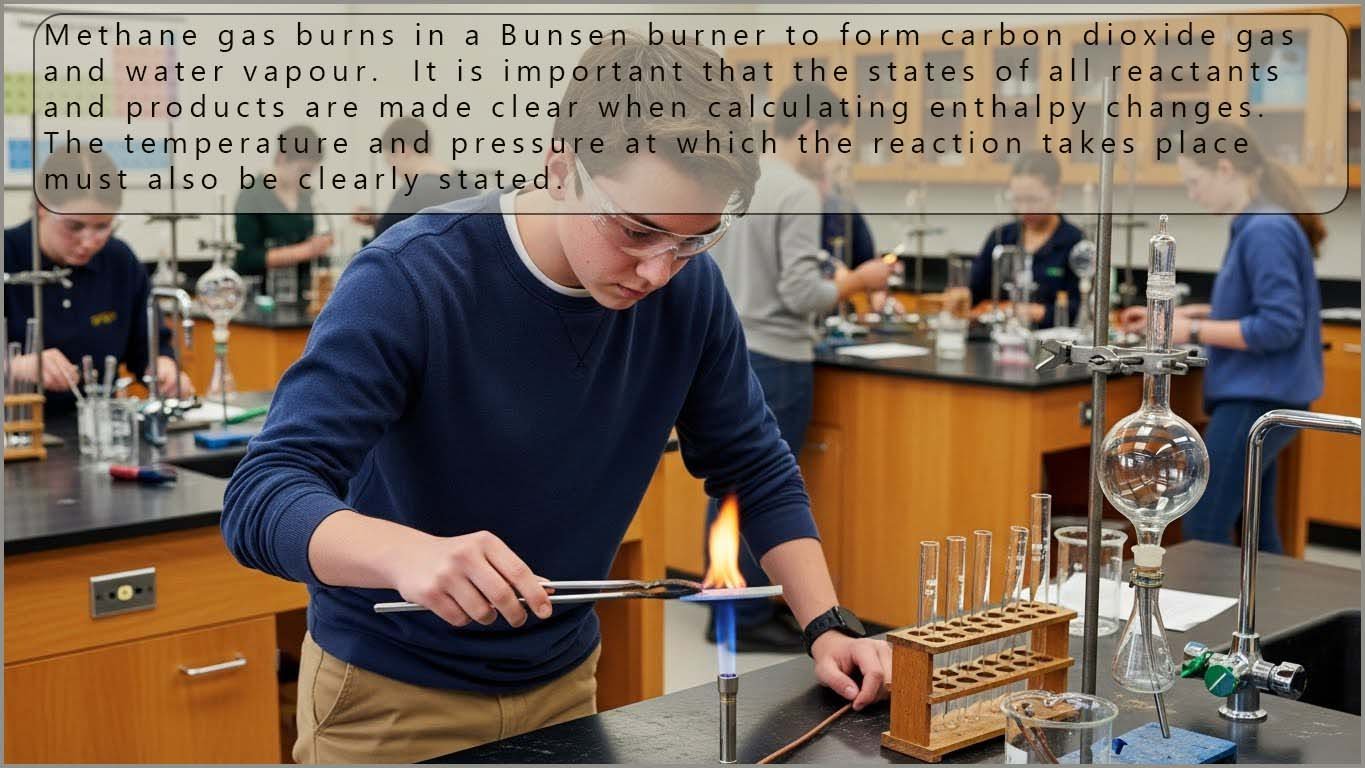
As an example consider the combustion of methane gas in a Bunsen burner to form carbon dioxide and water. Two equations are shown below for this combustion reaction, however they appear to have different enthalpy of combustion values that differ by 88 kJ.
Now each of the two equations is balanced but it is vitally important that when we write equations to represent an enthalpy change (ΔH) that a number of other factors are made clear; these include:
Look at the two equations for methane burning again. Why is the enthalpy change for forming liquid water (−891 kJ) more exothermic than forming water vapour (−803 kJ)?
Answer: Condensation is an exothermic process.
When water vapour (g) turns into liquid water (l), heat energy is released to the surroundings. This extra energy makes the overall enthalpy change more negative.
When chemists measure enthalpy changes they need a fair way to compare one reaction with another. To do this everyone agrees to measure them under the same set of conditions known as standard conditions. If a reaction is measured under these conditions its enthalpy change can be compared directly with others.
Standard conditions mean:
While the standard state of a substance is defined as:
When all these conditions have been met then the enthalpy change of the reaction (ΔH) is called the standard enthalpy change and is given the symbol ΔHo.
You should learn this definition for the standard enthalpy changes (ΔHo):
The standard enthalpy change (ΔHo) for a reaction is the enthalpy change measured under standard conditions (298 K, 100 kPa), with all reactants and products in their standard states.
Try the quick quiz below to review your understanding of the work covered so far. Click the button to view the questions.
Answer these quick questions to check your understanding of enthalpy changes and standard conditions.
1) Which statement about enthalpy change is correct?
2) Which set of values best matches standard conditions used in chemistry?
3) For a exothermic reaction, which sign is correct for ΔH?
4) “Standard state” means the substance is…
The standard enthalpy of combustion of a substance is the enthalpy change measured under standard conditions (298 K and 100 kPa) when 1 mole of the substance is completely burned in oxygen. As always, all reactants and products must be in their standard states.
It’s important to remember what standard state actually means. At 298 K and 100 kPa, the most stable form of water is a liquid, whereas methane, oxygen and carbon dioxide are all gases.
This means that, for methane, the correct equation to use when quoting the standard enthalpy of combustion is:
This equation can represent the standard enthalpy of combustion of methane (ΔcHo), provided that the enthalpy change of −891 kJ was measured under standard conditions.
Below are a few more equations to represent the standard enthalpy of combustion of few common substances:
Look at the equation for the standard enthalpy of combustion of hydrogen. Why must water be written as a liquid and not as a gas?
Answer: Standard enthalpy changes must use standard states.
At 298 K and 100 kPa, the most stable form of water is a liquid, not a gas. Writing water as a liquid ensures the equation represents the standard enthalpy of combustion.
Water is shown as a liquid because standard enthalpy changes always use standard states.
Carbon is written as a solid here because this is its standard state.
Only one mole of ethanol is burned; the coefficients in the equation are adjusted to keep this true.
Try the quick quiz below to review your understanding of the work covered so far. Click the button to view the questions.
Answer the questions below to check your understanding of standard enthalpies of combustion.
1) Which definition correctly describes the standard enthalpy of combustion?
2) In a standard enthalpy of combustion equation, what is the standard state of water at 298 K?
3) Why is the enthalpy change for combustion always negative?
There are many types of enthalpy changes that you will learn about as you complete your A-level chemistry course and unfortunately you will need to learn and be able to apply these definitions for all the enthalpy changes you meet. The definition of the standard enthalpy of combustion was given above as:
The standard enthalpy of combustion of a substance is the enthalpy change measured under standard conditions (298 K and 100 kPa) when 1 mole of the substance is completely burned in oxygen. As always, all reactants and products must be in their standard states.
The standard enthalpy of formation of a compound (ΔfHo) is defined as:
The enthalpy change when 1 mole of a compound is produced from its elements under standard conditions, with all reactants and products being in their standard states.
For example the equation to show the standard enthalpy of formation (ΔfHo) of methane; which is of course a hydrocarbon which consists of only the elements carbon and hydrogen would be:
You may be wondering what the C(graphite) symbol for carbon means in the equation above, well the element carbon exists in several different forms (allotropes); for example including diamond and graphite. The most stable allotrope of carbon under standard conditions is graphite, which is why it is used for enthalpy change calculations. At 100 kPa and 298 K the most stable state for elemental hydrogen, as I am sure you are aware, is a small gaseous diatomic molecule (H2(g)).
You should be aware that when you come to carry out enthalpy calculations using enthalpies of formation, the standard enthalpy of formation of an element is by definition 0. This may not at first seem obvious but if you think about what an enthalpy change of formation is then it should be apparent. The enthalpy of formation (ΔfHo) is the enthalpy change (that is the amount of heat energy released at constant pressure) when a substance is formed from the most stable form of its elements. However with an element there is no enthalpy change taking place because the reactants and products are the same. The element is already formed so no enthalpy of formation is possible: the element cannot react to form itself. Setting the standard enthalpy of formation for an element to 0 is a sensible reference point, since we cannot measure the absolute enthalpy of substances anyway; we can only measure enthalpy changes.
If you were asked to write an equation to show the standard enthalpy of combustion (ΔcHo) of carbon, then hopefully you would write:
This equation satisfies the definition for the standard enthalpy of combustion since we have 1 mole of the carbon (graphite) being completely burned in oxygen; with all the reactants and products in their standard states. We can assume that the reaction takes place at 100 kPa and 298 K.
However what would you write if you were asked to write an equation to show the standard enthalpy of formation of carbon dioxide gas? Well hopefully you would write the equation shown below:
This equation satisfies the definition for the standard enthalpy of formation of carbon dioxide since 1 mole of carbon dioxide is produced from its elements under standard conditions, with all reactants and products being in their standard states. The two equations written above are identical - yet they meet the definitions for the two different enthalpy changes. This is not an uncommon situation in thermodynamics when we are dealing with enthalpy changes. It may seem tedious, but you should make an effort to learn the definitions for the many enthalpy changes you will meet in your chemistry course because you will come across many such similarities. For example, try writing an equation to represent the standard enthalpy of formation of water and the standard enthalpy of combustion of hydrogen; they are also identical.