Remember the link: the Haber process makes ammonia, and the Ostwald process uses this ammonia to make nitric acid.
Non-metal oxides dissolve in water to form acids — this idea is tested often.
Hot temperatures (800–950°C) + a platinum/rhodium catalyst → oxidation of ammonia to NO.
Don’t mix up the gases: NO is colourless, NO₂ is the brown gas that makes nitric acid.
Always include state symbols: NH₃(g), O₂(g), NO₂(g), HNO₃(aq).
The exam loves questions where you write the neutralisation equation for ammonium nitrate.
Ammonium nitrate is perhaps the most common compound found in many
fertilisers. It can be made by reacting an alkaline solution of
ammonium hydroxide
with nitric acid. The word and symbolic equations for this reaction are given below:
The two reactants in the above equation; the ammonium hydroxide and the nitric acid are both obtained thanks to the Haber process. Now recall that ammonium hydroxide can be made by dissolving dissolving ammonia
gas in water:
ammonia(g) + water(l) ⇌ ammonium hydroxide(aq)
NH3(g) + H2O(l) ⇌ NH4OH(aq)
Obtaining large amounts of ammonium hydroxide should therefore be straightforward since ammonia gas is readily available; it can be obtained in large quantities from the
Haber process. The other reactant; nitric acid
is also obtained thanks to the Haber process.
Acidic non-metal oxides
One way to make
an acidis to simply to dissolve a non-metal oxide in water, for example the word equations below show how some common everyday acids are made by dissolving non-metal oxides in water:
Non-metal oxide + water → acid
Carbon dioxide + water → carbonic acid (H2CO3)
Sulfur dioxide + water → sulfurous acid (H2SO3)
Sulfur trioxide + water → sulfuric acid (H2SO4)
Nitrogen dioxide + water → nitric acid (HNO3)
Making nitric acid
The word equation above shows that to make nitric acid you simply have to dissolve nitrogen dioxide gas in water. However one of the main problems with making nitric acid is actually getting the nitrogen dioxide gas that can then be dissolved in water to make the nitric acid. Nitrogen gas is a very unreactive gas
so simply burning nitrogen gas in air/oxygen
as shown in the eqaution below to make the nitrogen dioxide gas will not work!
nitrogen(g) + oxygen(g) → nitrogen dioxide (g)
Burning ammonia gas
So what is needed is another way of preparing nitrogen dioxide gas. What about burning ammonia?Ammonia burns in oxygen with a
yellowish coloured flame; as shown in the image below:
However there is a problem, ammonia burns to produce
nitrogen gas and water. No
nitrogen dioxide gas is produced, as we might
have hoped:
ammonia(g) + oxygen(g) → nitrogen(g) + water(l)
However by altering the reaction conditions above it is possible to obtain nitrogen dioxide gas, the gas needed to make
nitric acid.
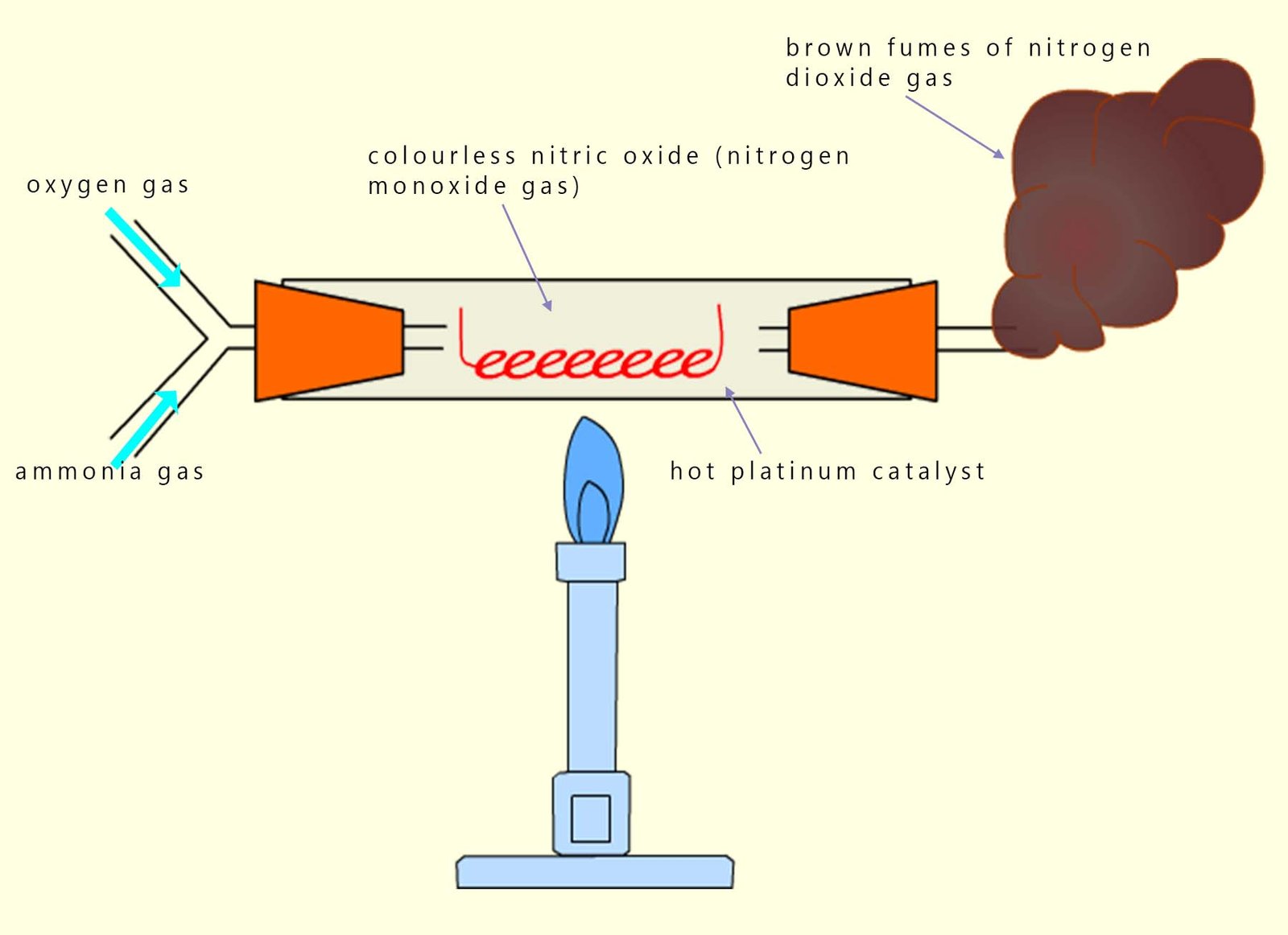
All that is needed is the introduction of a platinum catalyst and some heat, as outlined in the image below:
This time in the presence of a platinum catalyst the ammonia
gas is oxidised to give nitrogen monoxide gas and water vapour:
Nitrogen monoxide (NO) gas which is often called nitric oxide is a colourless
gas that forms inside the combustion tube. However
on exposure to air/oxygen the nitrogen monoxide gas is immediately oxidised
to form reddish-brown nitrogen dioxide gas.
Now
Nitrogen dioxide is a reddish-brown toxic gas with a bleachy smell, it dissolves in water in the presence of air/oxygen to form
nitric acid, this is outlined below:
Self-check: Match the gases used in The Ostwald Process with their colours and properties
Simply click on the gases/substances and match them up with their correct description in the right-hand column in the activity below:
Match the gas to its colour and role in the Ostwald process
Tap a gas on the left, then tap its matching description on the right.
Gases / substances
Descriptions
The Ostwald process for making nitric acid
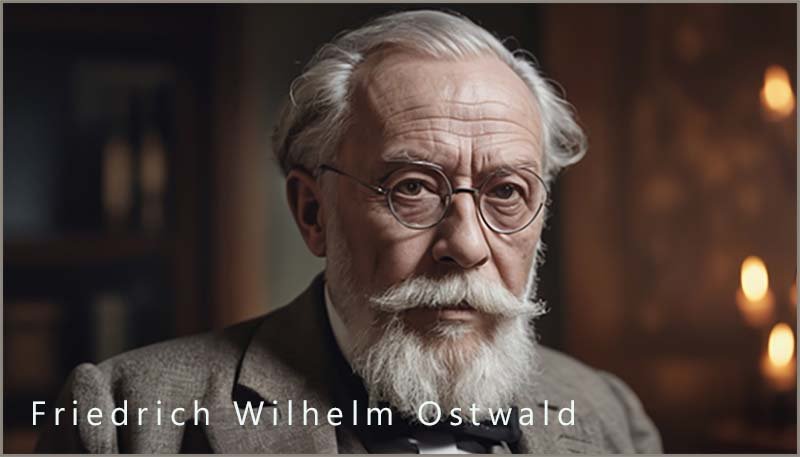
Now that a method had been found to make nitrogen dioxide gas , all that was needed was a method to scale up the process to produce large amounts of nitric acid. The scientist who devised the industrial process for the large scale manufacture of nitric acid was the German Nobel prize winning chemist Friedrich Wilhelm Ostwald. Ostwald dissolved nitrogen dioxide gas in the presence of air/oxygen and water to make nitric acid, an equation for this reaction is shown below:
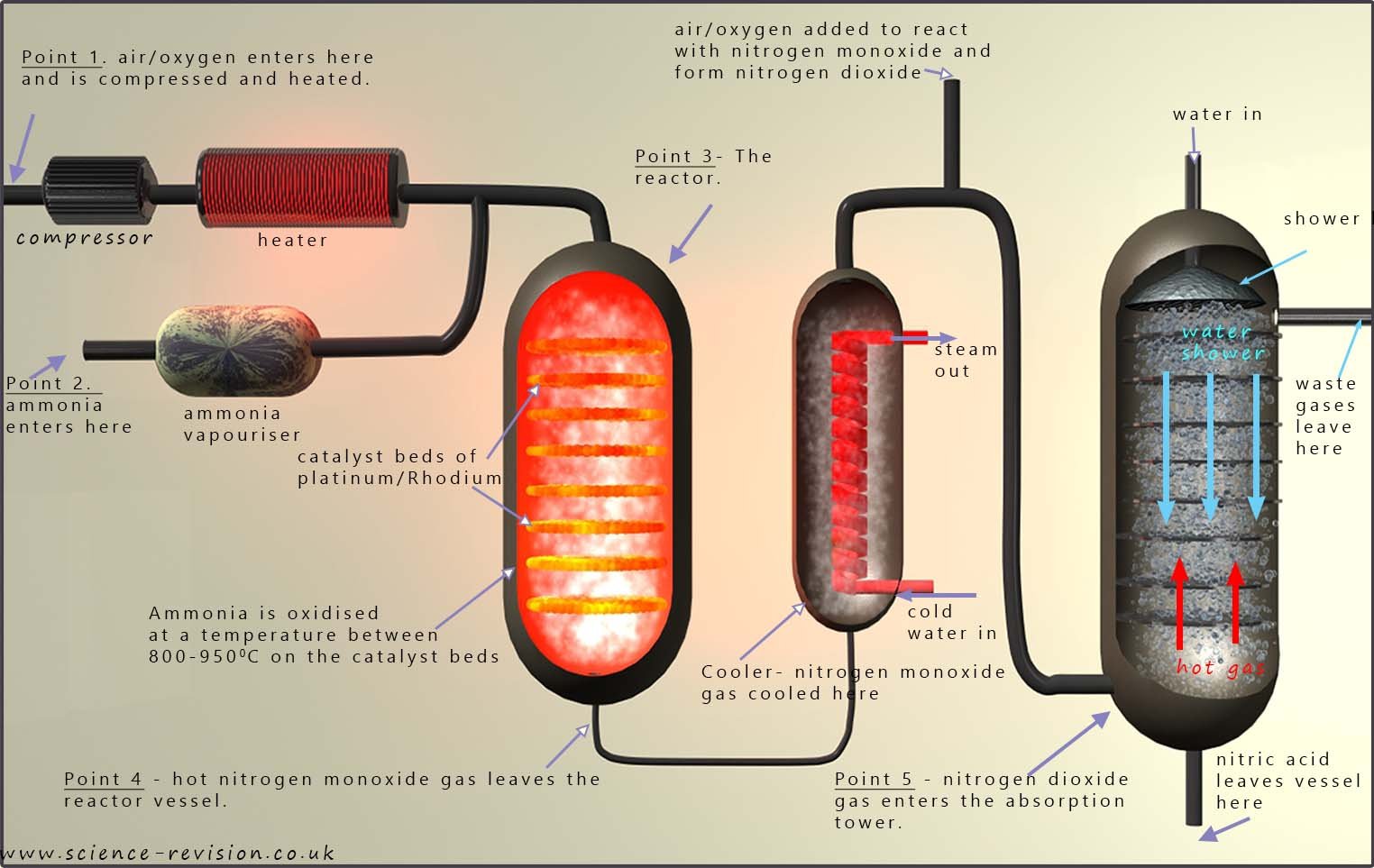
The image below shows an outline of the
Ostwald process for making nitric acid, at first glance it might look complicated but it is actually very straightforward.
Starting from the left hand-side of the image:
At point 1 in the image above oxygen gas from the air enters a compressor where it is compressed to between
4-10 atmospheres pressure and then pre-heated before it enters the reactor.
At point 2 in the image above liquid ammonia from the Haber process
enters the vaporiser where it is turned into a gas.
Next the mixture of oxygen and gaseous ammonia
enter the reactor.
At point 3- Inside the reactor the ammonia is oxidised to nitrogen monoxide gas
in a high temperaturecatalysed reaction.
A platinum/rhodium catalyst is used and temperatures inside the reaction vessel are in the range 800-950OC. This reaction is highly exothermic
and releases a large amount of heat energy. This heat can be used to generate electricity or used as a heat source to
pre-heat gases elsewhere in the reaction. An equation for the reaction that takes place inside the reactor is shown below:
At point 4- The nitrogen monoxide gas leaves the reactor and is cooled
in the cooler. Here cold water is turned into steam as
the hotnitrogen monoxide loses its heat energy. The cool
nitrogen monoxide gas now joins with oxygen to
form nitrogen
dioxide gas:
At point 5 - The final vessel in the image is called the absorption tower. Here a shower of water falls from the top of the tall tower and meets the nitrogen dioxide gas as it rises up from the bottom of the tower.
The nitrogen dioxide gas dissolves in the shower of water to form nitric acid. The nitric acid then leaves at the base of the absorption tower and is collected in a large tank.
The nitric acid produced can then be reacted with ammonium hydroxide solution, made by dissolving
ammonia in water. This neutralisation reaction will then form
ammonium nitrate:
The activity below summarises each of the steps that take place during the Ostwald Process. Put each of the steps into your own words or perhaps build a set of flashcards which cover the main points with equations for the reactions that take place.
Follow the steps in the Ostwald process
Tap a step number to see what happens at that point in the plant.
Step 1 – Air compressor
At point 1, oxygen from the air is compressed and warmed before it reaches the reactor.
Air is compressed to about 4–10 atmospheres.
The gas is then pre-heated so it is hot when it enters the reactor.
This gives fast reaction when it meets the ammonia.
Step 2 – Vaporiser and mixing
At point 2, liquid ammonia from the Haber process is turned into a gas and mixed with the compressed air.
Liquid NH₃ enters the vaporiser and becomes a gas.
Gaseous ammonia then mixes with hot, compressed oxygen.
This mixture flows into the hot, catalyst-filled reactor in step 3.
Step 3 – Reactor: ammonia → NO
At point 3, the mixture of ammonia and oxygen passes over a hot platinum/rhodium catalyst.
Temperature inside the reactor is about 800–950 OC.
Ammonia is oxidised to colourless nitrogen monoxide (NO) and water.
The reaction is highly exothermic – the heat released can be used to pre-heat gases or to generate electricity.
Overall reaction in the reactor:
4NH₃(g) + 5O₂(g) → 4NO(g) + 6H₂O(l)
Step 4 – Cooler: NO → NO₂
At point 4, hot nitrogen monoxide gas is cooled and then reacts further with oxygen.
The hot gases pass through a cooler; cold water is turned into steam as the gases lose heat.
The cooled NO now reacts with O₂ to form brown nitrogen dioxide (NO₂).
This is the important NO₂ gas needed to make nitric acid.
Step 5 – Absorption tower: NO₂ → HNO₃
At point 5, nitrogen dioxide gas rises up through the absorption tower while a shower of water falls from the top.
NO₂ dissolves in water in the presence of oxygen to form nitric acid (HNO₃).
The nitric acid solution leaves at the bottom of the tower and is collected in large tanks.
This HNO₃ can then react with ammonium hydroxide to make ammonium nitrate fertiliser.
Key points
Common Misconceptions ⚠️
Students often think ammonia burns to make NO₂ ❌
It actually makes N₂ and H₂O unless a catalyst is present.
NO and NO₂ get mixed up a lot 🤯
NO is colourless ✔
NO₂ is brown ✔
Nitric acid is NOT made in the reactor 🔥
It forms in the absorption tower when NO₂ dissolves in water.
Ammonia is a basic gas that
is very soluble in water. Ammonia
gas dissolves in water to
form an alkaline solution of ammonium hydroxide.
Non-metal oxides are acidic. This means that they dissolve in
water to form acids.
To make nitric acid the brown gas
nitrogen dioxide is dissolved in water.
The simplest way to make nitrogen dioxide gas is by burning
ammonia in the presence of a platinum catalyst. This forms the colourless
nitrogen monoxide which immediately oxidises in air to form the brown gas
nitrogen dioxide.
Self-check: Review of main points in The Ostwald Process
Click the button below for a quick quiz on the main points of The Ostwald Process.
Multiple-choice review
Tap an answer for each question. You can change your mind if you get one wrong.
1. Which two industrial processes are linked to make ammonium nitrate fertiliser on a large scale?
2. What happens to ammonia in the hot, catalyst-filled reactor in the Ostwald process?
3. Which statement about the brown gas in the Ostwald process is correct?
4. Where in the Ostwald process is nitric acid (HNO₃) actually formed?
5. Which conditions are used in the reactor in the Ostwald process?
6. Why is the main reaction in the reactor described as exothermic?